On December 11, 1994, Philippine Airlines Flight 434, a Boeing 747, departed Manila for Tokyo with a stopover in Cebu. The flight, captained by veteran pilot Eduardo Reyes, was filled with 273 passengers, many of them Japanese tourists returning home.
About two hours from Tokyo, as the plane cruised at altitude, a massive explosion ripped through the cabin. The blast originated from under seat 26K, instantly ending the life of the passenger, 29-year-old Japanese engineer Haruki Ikegami, and tearing a two-foot hole in the cabin floor.
Smoke filled the cabin, and panic erupted. Flight attendants, led by purser Fernando Bayot, moved quickly to calm passengers and aid the wounded.
Bayot discovered Ikegami’s catastrophic injuries; his lower body was gone. To prevent further panic, the crew covered him with a blanket and pretended to administer oxygen.
In the cockpit, the explosion sent a violent shudder through the aircraft, banking it sharply to the right and disabling the autopilot system.
Captain Reyes, a former Philippine Air Force pilot, took manual control as systems engineer Dexter Comendador went to inspect the damage.
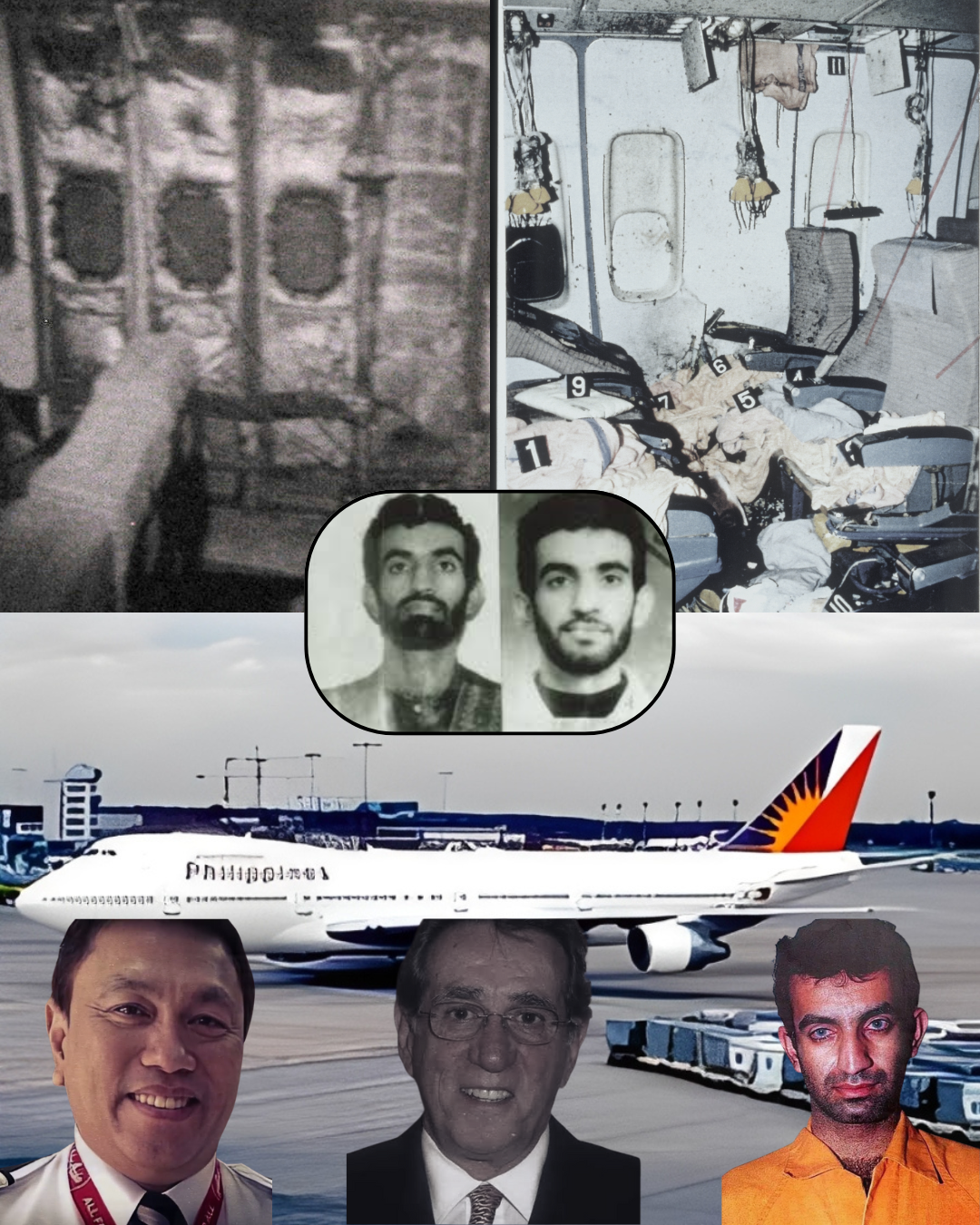
Comendador found a gaping hole leading to the cargo bay but made a critical discovery: the blast, though severe, had missed the central fuel tank and had not breached the plane’s outer skin. The plane was still structurally intact, but its flight controls were crippled.
Captain Reyes made the decision to attempt an emergency landing at Naha Airport in Okinawa. However, the plane’s controls were unresponsive; the autopilot wouldn’t disengage properly, and the ailerons, which control banking, were damaged. Their initial attempts to turn toward the airport failed.
For nearly an hour, Captain Reyes and his crew fought the aircraft. Passengers, terrified and aware of the severity of the situation, prepared for the worst; one reportedly wrote a last will and testament.
In a desperate, brilliant feat of airmanship, Captain Reyes realized he could steer the massive jet by manually manipulating the engine throttles—increasing power on the left side and decreasing it on the right to force the plane into a gradual turn. Using this unorthodox method, he slowly, painstakingly, aligned the 747 with the Naha runway.
After dumping fuel to reduce weight and landing speed, the crew prepared for a high-risk landing without normal controls.
They successfully brought the plane down, stopping with only meters of runway to spare. All 272 remaining passengers and crew evacuated safely. Captain Reyes and his team were hailed as heroes.
The investigation immediately confirmed this was not an accident, but a bombing. Investigators found the bomb’s components, including a modified Casio digital watch as a timer and a 9-volt battery manufactured in the Philippines.
This clue led them to Manila, where a bizarre apartment fire just weeks later would blow the case wide open.
Police, responding to a chemical fire, found bomb-making materials, plans, and a laptop belonging to a Pakistani national. The laptop contained details of “Project Bojinka,” a massive terrorist plot.
The man who escaped that apartment was Ramzi Yousef, the same terrorist who masterminded the 1993 World Trade Center bombing.
The investigation revealed Yousef had boarded Flight 434 in Manila under a fake name, assembled the bomb in the lavatory, and planted it under seat 26K during the short hop to Cebu.
He disembarked in Cebu, leaving the timer to detonate the bomb hours later, precisely when the plane was scheduled to be over the ocean, ensuring its complete destruction. The bomb was placed specifically over the central fuel tank.
Yousef’s plan failed for three reasons: the flight was delayed, meaning the explosion occurred closer to land; the plane used was a specific 747 model with a slightly different fuel tank configuration; and most importantly, Haruki Ikegami’s body absorbed the brunt of the blast, shielding the fuel tank.
Flight 434 was merely a “test run.” Yousef’s laptop detailed the full extent of Project Bojinka: a plan to simultaneously place similar bombs on 11 different American airliners, resulting in the potential loss of over 4,000 lives.
His second plot, also on the laptop, was to assassinate Pope John Paul II during his upcoming visit to Manila.
Yousef was captured in Pakistan in 1995, extradited to the US, and sentenced to life in prison.
Captain Reyes and his crew were honored by the Philippine president and lauded by the US Senate for their heroism, which not only saved their flight but led to the foiling of one of the most ambitious terror plots of the 20th century.
News

The Toxic Price of Rejection: OFW’s Remains Found in a Septic Tank After Coworker’s Unwanted Advances
South Korea, a hub for Asian development, represents a major aspiration for many Filipino Overseas Workers (OFWs), who seek employment…

The Final Boundary: How a Starving Tricycle Driver Exacted Vengeance at a Homecoming Party
On November 28, 2009, in Angat, Bulacan, a lavish homecoming party for two returning travelers ended in a catastrophic tragedy….

The 12-Year Ghost: Why the Woman Behind Vegas’s ‘Perfect Crime’ Chose Prison Over Freedom
On October 1, 1993, at the Circus Circus Casino in Las Vegas, a crime unfolded in minutes that would be…
The Fatal Soulmate: How a British Expat’s Search for Love Online Became a $1 Million Homicide Trap
In 2020, in a comfortable apartment overlooking the city of Canberra, Australia, 58-year-old British expatriate Henrick Collins lived a successful…
The Cost of Negligence: Firefighter Ho Wai-Ho’s Tragic Sacrifice in Hong Kong’s Inferno
The catastrophic fire that engulfed seven towers of the Wang Fook Court residential complex in Hong Kong was a disaster…

The KimPau Phenomenon: How “The A-List” Sparked Queen Kim Chiu’s Fierce Career Revolution
The Filipino entertainment industry is currently witnessing a stunning career metamorphosis, all thanks to the sheer, raw power of the…
End of content
No more pages to load