
The Unthinkable Turn: A Filipino Officer’s Role in a Global Drug Scandal
The O’Connell Bridge in Dublin, Ireland, often serves as a mundane backdrop for the less visible aspects of a societal crisis.
It is here that the open exchange of controlled substances—a scene so normalized that it barely warrants a second glance—epitomizes a nation grappling with a deepening concern.
Reports from the United Nations place Ireland disturbingly high in the global ranks for usage of a highly addictive substance, signaling a major challenge for its future.
For users, this challenge is simply a continuous pursuit of fleeting happiness, easily accessible wherever public gatherings occur.
The Irish government, determined to stem the tide of this corrosive flow and protect its citizens, focused its considerable resources on a single, primary objective: intercepting the supply lines.
Surrounded by water, the nation’s ports and territorial waters became the critical battlegrounds against drug smugglers who sought to poison the country for profit.
The goal to entirely eradicate these sources was, predictably, a difficult one, often leading to frustrating near-misses.
However, in September 2023, Irish authorities achieved a historic victory—a massive interdiction operation that was immediately hailed by local reporters as the largest drug haul in the nation’s history.
The seized drugs, estimated to be worth well over $160 million (equivalent to billions of pesos), represented a major financial and logistical blow to an organized crime network.
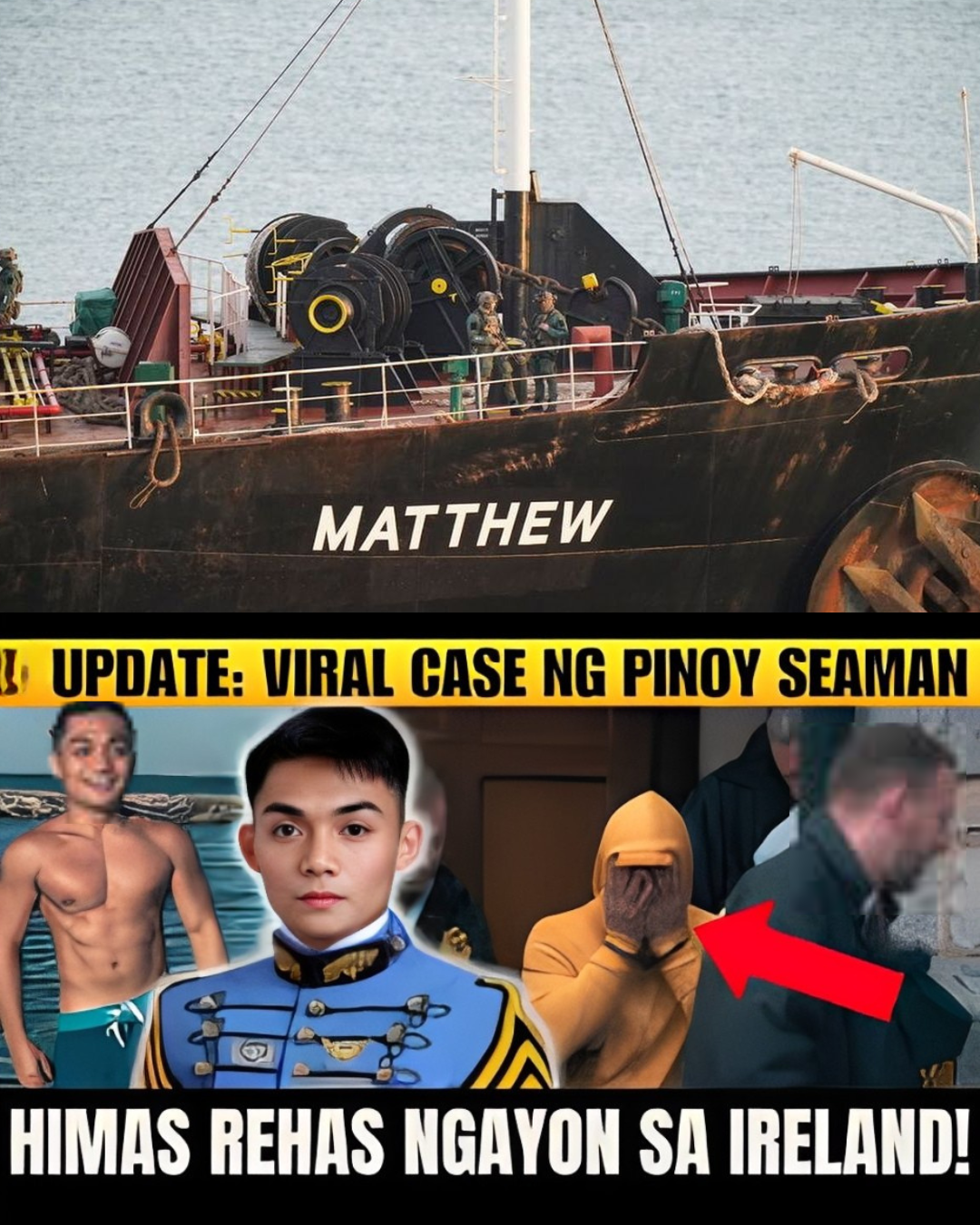
The focus of this monumental seizure centered on the MV Matthew, a cargo ship operating under the Panama flag.
The news instantly dominated headlines across Ireland, prompting the rapid prosecution of eight men believed to be the masterminds and facilitators of the smuggling attempt.
The identities of those arrested quickly became public, including nationals from Iran, the United Kingdom, Ukraine, and, most surprisingly to those back home, the Philippines.
While the story was an immense issue in Ireland, its full significance took time to reach the Philippines, igniting a mixed, immediate reaction upon arrival.
Some expressed harsh judgment, believing the individual deserved consequences for violating international law.
Yet, a quieter voice emerged—a plea from a few who believed a fellow countryman, 31-year-old Harold Estuesta, might have been unjustly trapped in a circumstance beyond his control.
The Pride of the Family: Harold Estuesta’s Ideal Life
Harold Estuesta was not driven to sea by the kind of crushing poverty that forces many Filipinos to seek work abroad.
Instead, his motivation was twofold and profoundly personal: to realize his own ambitions and, more importantly, to inspire pride in his parents.
His parents, Joe and Elizabeth, hailed from educated backgrounds, with Elizabeth having chosen to sacrifice a burgeoning career to focus on raising their children.
Their dedication paid off; Harold, their eldest, demonstrated exceptional academic promise early on.
Supported by his parents, he enrolled in the esteemed Maritime Academy of Asia and the Pacific (MAAP), where he was noted not only for his intelligence but also for his diligent work ethic and excellent command of the English language.
His parents’ pride reached its peak when Harold graduated and was recognized as one of the 10 Outstanding Maritime Students of the Philippines in 2015—a truly immense honor.
Armed with his determination and diploma, Harold secured a position as a Third Officer with Fleet Management Limited in 2016, quickly taking on responsibilities for the vessel’s safe passage, cargo operations, and crew management.
He later transitioned to Stealth Maritime Corporation, based in Greece, maintaining his impressive career progression.
To his parents and siblings, Harold was the ideal son—an exceptional role model and a kind friend who never forgot his humble roots.
His years of experience and sharp skills earned him a significant promotion when he applied to join the MV Matthew: Second Officer, a rank many older seafarers spend decades attempting to achieve.
This promotion was a testament to Harold’s dedication, making him a figure of both admiration and, perhaps inevitably, envy among his peers.
As Second Officer, Harold’s duties were critical, spanning navigation, communications, and operations on the bridge—responsibilities that demand meticulous integrity and trust.
His parents, confident in his stellar record, believed Harold’s career trajectory was limitless, celebrating his appearance, intelligence, and perceived strong moral character.
They saw their eldest son as nothing short of a good, honorable man.
However, before the year 2023 concluded, this perfect image—everything they thought they knew about Harold—was about to undergo a profound and devastating change.
The arrest of their 31-year-old son, along with seven foreign nationals, on charges related to possession and smuggling of controlled substances, challenged their core beliefs.
Their initial, natural instinct was denial—to disbelieve the reports until they could speak with Harold directly.
The Conspiracy Unmasked: From ‘Not Guilty’ to Guilty Plea
On October 5, 2023, Harold Estuesta made his first court appearance, initially entering a plea of “not guilty.”
He claimed ignorance, asserting that the cargo’s documents listed the contents merely as “spare parts” and that he had been manipulated by superiors into a situation he didn’t comprehend.
Despite his fervent plea of innocence, the prosecution pushed forward with the charge of conspiracy to possess and supply a controlled substance.
His family and supporters rallied, some speculating that his success had made him a target of jealousy, leading to his wrongful implication.
This narrative persisted until April of the following year, when a dramatic turn shocked observers and subtly shifted public opinion.
In a move that contradicted his family’s hopes for a full exoneration, Harold Estuesta reversed his earlier stance and entered a plea of guilty to the charges filed against him.
For legal observers, this plea was a clear admission that the evidence gathered by the authorities was overwhelmingly strong and undeniable.
The court documents later revealed that Harold had been aboard the MV Matthew for a short period before the criminal operation commenced.
The ship, sailing from Curaçao, was already under intense surveillance by the Garda National Drugs and Organized Crime Bureau, an agency equivalent to the police in the Philippines, acting on a highly credible tip.
The informer, possessing strong evidence, suggested that the cargo vessel was being used by drug smugglers to transport a massive shipment of illicit drugs into Ireland.
The multi-agency investigation quickly uncovered the movements of a fishing trawler, the FB Castle, purchased by two men believed to be members of a Dubai-based organized crime group.
Cell phone data confirmed that these two individuals were in direct communication with collaborators aboard the MV Matthew from September 22 to 24, 2023.
Their mission was to intercept the cargo ship in the southern Irish waters and transfer the drugs, referred to euphemistically as “food,” using signaling methods like flares.
However, the transfer plan was repeatedly foiled by a combination of strong sea waves, engine trouble, and issues with Wi-Fi signal.
This continuous failure led to the cargo ship being stopped by the Irish Coast Guard on September 24, prompting the conspirators to use the excuse of “strong waves” to avoid suspicion.
In a frantic attempt to salvage the operation, the criminals abandoned the trawler transfer idea and decided to use the cargo ship’s life raft to deliver the drugs.
To further conceal their activities, they meticulously removed all identifying marks from the lifeboat.
The situation became critical when the trawler carrying the two conspirators got into distress and was rescued by the Navy, alerting the crew of the MV Matthew to the heightened risk.
The crew then decided to use a life raft to drop the contraband at a distance of 13 nautical miles from the mainland, a spot they mistakenly believed was outside Irish jurisdiction.
Their false sense of confidence stemmed from the belief that they were in the “contiguous zone,” where maritime law supposedly protected them from apprehension.
In reality, this zone is still under Irish jurisdiction, providing the authorities the right to enforce their laws.
The Chase and the Warning Shots
Before the crew could execute the final plan, the Coast Guard intervened, ordering the MV Matthew to proceed directly to the port in Cork.
Panic erupted among the conspirators aboard the cargo ship, as evidenced by their frantic group chat messages.
An individual identified as “Captain Noah,” presumably based in Dubai, attempted to calm the crew, insisting that the method of boarding would be different since they were supposedly in international waters.
The anxiety escalated further when Customs officials and the Irish Navy arrived, demanding to board the MV Matthew.
The criminals initially resisted, citing the sanctity of “international waters,” but the Captain ultimately steered the cargo ship away from Ireland’s territory, triggering a full-scale naval pursuit.
During the high-speed chase, which lasted for over an hour, Captain Noah ceaselessly sent audio messages, urging the crew to remain calm and confident.
When the cargo ship persistently ignored orders, the Navy issued a warning shot, signaling their readiness to use force.
In full panic mode, the criminals were ordered to delete all communication exchanges, though it was too late.
To prevent the seizure, Captain Noah desperately ordered the crew to incinerate the lifeboat containing the drugs.
Ultimately, the Irish Defense Force Army Ranger Wing, an elite unit, was deployed via helicopter, successfully boarding and seizing control of the MV Matthew despite adverse weather conditions.
The cargo ship was then returned to Ireland, where the partially burned remains of six large bags were found, containing over two tons of drugs with an estimated value of $160 million.
Eight individuals were arrested, including the ship’s captain and, critically, Harold Estuesta.
The Price of Becoming an Enabler
The digital forensic team’s ability to retrieve the deleted, encrypted group chat messages was the definitive blow to the defense.
The evidence proved that Harold Estuesta was not only part of the communication but, as the Second Officer, he was instrumental in creating the delaying tactics.
His recorded voice was played in court, where he was heard challenging the Irish Warship, claiming they were outside of the “contagious zone” and demanding they not endanger the commercial vessel.
The investigation proved that Harold had known since early September that the ship would be used for smuggling.
Instead of reporting the crime, he chose to become an active participant.
In the sentencing hearing, the judge acknowledged that Harold was neither the drug lord nor the owner of the cocaine.
However, the judge stressed that Harold’s actions made him the essential enabler, whose technical expertise allowed the criminal tactics to succeed.
Specifically, the judge cited his deceitful excuses, which successfully delayed the Irish authorities’ boarding of the MV Matthew.
Harold maintained that his participation was driven by fear, claiming he worried the criminals would cause him physical harm.
Nevertheless, the judge deemed his actions a clear violation of Irish law.
The sentencing reflected the gravity of the crime: the ringleader, Osena Direct, was sentenced to two decades in prison.
The captain of the MV Matthew received 17.5 years. Harold Estuesta, the talented Second Officer, was sentenced to five years imprisonment.
For his family, the shock of the guilty plea was eclipsed only by the devastation of the verdict.
The ideal son, the pride of their home, had thrown away a brilliant career and a life of integrity to become a key cog in a major international crime.
Harold Estuesta’s story serves as a painful reminder that the pursuit of ambition, when tainted by a dangerous choice, can lead to the profound loss of not only freedom but also honor, leaving behind only the wreckage of broken dreams and a family’s shattered pride.
News

The Toxic Price of Rejection: OFW’s Remains Found in a Septic Tank After Coworker’s Unwanted Advances
South Korea, a hub for Asian development, represents a major aspiration for many Filipino Overseas Workers (OFWs), who seek employment…

The Final Boundary: How a Starving Tricycle Driver Exacted Vengeance at a Homecoming Party
On November 28, 2009, in Angat, Bulacan, a lavish homecoming party for two returning travelers ended in a catastrophic tragedy….

The 12-Year Ghost: Why the Woman Behind Vegas’s ‘Perfect Crime’ Chose Prison Over Freedom
On October 1, 1993, at the Circus Circus Casino in Las Vegas, a crime unfolded in minutes that would be…

The Fatal Soulmate: How a British Expat’s Search for Love Online Became a $1 Million Homicide Trap
In 2020, in a comfortable apartment overlooking the city of Canberra, Australia, 58-year-old British expatriate Henrick Collins lived a successful…

The Cost of Negligence: Firefighter Ho Wai-Ho’s Tragic Sacrifice in Hong Kong’s Inferno
The catastrophic fire that engulfed seven towers of the Wang Fook Court residential complex in Hong Kong was a disaster…

The KimPau Phenomenon: How “The A-List” Sparked Queen Kim Chiu’s Fierce Career Revolution
The Filipino entertainment industry is currently witnessing a stunning career metamorphosis, all thanks to the sheer, raw power of the…
End of content
No more pages to load